How Vroep decides
Vroep plans every route on streets where your scooter is allowed according to our data. Where it isn't sure, it says so.
The signs to look out for
These are the signs you'll see most. They decide whether you may use the cycle path or must take the road.
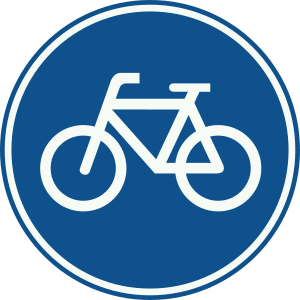 Cycle path (G11)Blue plate: cycle path, mandatory. Yellow plate: not allowed.
- Snorfietsen
niet toegestaan ‘Snorfietsen niet toegestaan’The plate under a cycle-path sign: no snorfietsen. Blue plate: not allowed, take the road. On most cycle paths inside the A10. 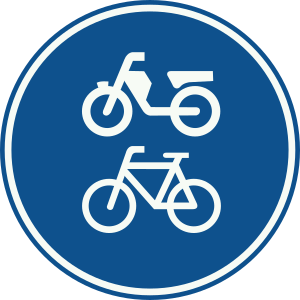 Cycle and moped path (G12a)Blue and yellow plate: cycle path, mandatory. Yellow: max. 30 km/h.
 Cycle path, not mandatory (G13)Blue plate: allowed, on petrol with the engine off. Yellow plate: not allowed.
Road or cycle path
Snorfiets with a blue plate
- Inside the A10: usually the road. Most cycle paths inside the ring carry the plate ‘snorfietsen niet toegestaan’ (no snorfietsen; Staatscourant 2018, 71559, since 8 April 2019).
- Outside the A10: usually the cycle path. Where a cycle path with a round blue sign (G11) or a cycle and moped path (G12a) runs beside the road, you must use it, except on a few paths in Noord that the city's decision closes too.
- Cycle paths with a rectangular sign. On a path with a rectangular ‘Fietspad’ sign (G13), a petrol engine must be off. On petrol, Vroep routes you around it.
- One-way streets. Against the direction only when the plate under the sign shows a moped.
- Footways. There you walk beside your snorfiets. Vroep shows where you must get off.
Bromfiets with a yellow plate
- Usually the road. On a yellow plate you ride on the road, at most 45 km/h, less where a sign says so (most Amsterdam streets are 30).
- Cycle and moped path (G12a): always take it. At a round blue sign with a bicycle and a moped you must take the path, at most 30 km/h in built-up areas.
- Ordinary cycle paths: never. A cycle path with a round blue sign showing only a bicycle (G11) or a rectangular ‘Fietspad’ sign (G13) isn't for a bromfiets. Vroep doesn't route you over it.
- One-way streets and footways work as for a snorfiets: against the direction only when the plate under the sign shows a moped, and on a footway you walk.
A summary, not legal advice. The signs on the street always come first.
When Vroep isn't sure
Then Vroep says ‘Follow the signs here’. Vroep works with open map data, the sign register and the city's traffic decisions, and they aren't complete everywhere.
The zero-emission zone
Petrol scooters first registered in 2010 or earlier, or in 2025 or later, may not ride in the zone with the engine running: almost all of Amsterdam (Gemeenteblad 2024, 218513). If your trip crosses it and your scooter may not enter, Vroep shows the route but doesn't guide it, and says why.
Seen a mistake? Report it
If a route is wrong, stop somewhere safe and report it in the app: after your ride under ‘Something was wrong’, or in the steps under ‘Report a problem with this route’. A report never changes a route by itself; we check it first. More under Help.